
What “Engage Your Core” Actually Means
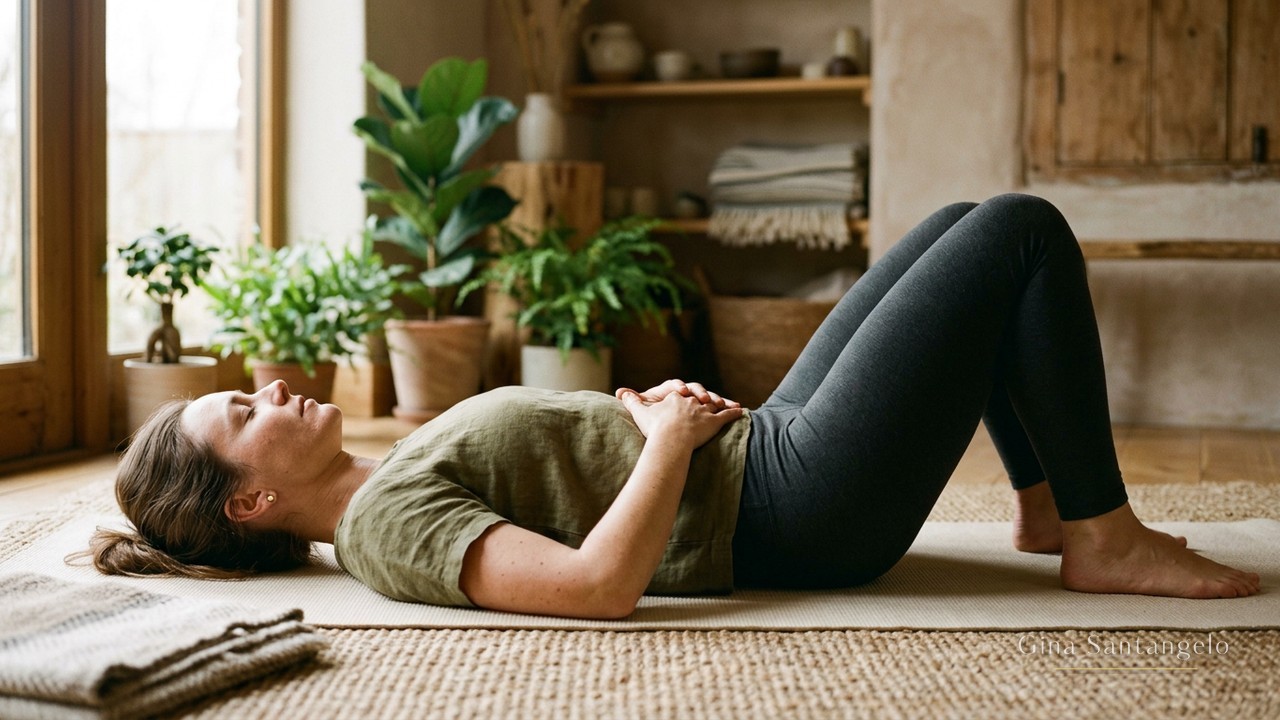
Most women have been told to do it. Very few have been told what it means, and many are doing the opposite. What the core actually is, why holding your breath undoes it, and how to find it.
Almost every woman I meet has been told to engage her core. Very few have been told what that actually means, and a surprising number are doing something closer to the opposite.
The core is not your abs
When most people picture the core they picture the front, the rectus abdominis, the muscle that shows as a six pack. It is the least interesting part of the story.
The core is better understood as a cylinder. The deep abdominal wall wraps around the sides. The pelvic floor forms the base. The diaphragm forms the lid. The deep spinal muscles run up the back. These work together to manage pressure inside the abdomen, which is what actually stabilises your spine.
Crunches train one wall of that cylinder. They do very little for the rest, which is why a woman can have visible abdominal definition and still have a back that gives out carrying shopping.
What "engage your core" really means
Not sucking in. Not bracing as though about to be punched. Not holding your breath, which is the most common version I see and the least useful.
What you are looking for is a gentle, continuous drawing in low in the abdomen, below the navel, while you keep breathing normally. Think of it as the sensation just before a cough, held lightly, rather than a hard squeeze.
Here is the test: if you cannot hold a conversation while doing it, you are gripping rather than engaging. Real core engagement is something you can maintain for a whole session, not a five second clench.
The breath is not separate from it
This is the part that changes things for most women.
Your diaphragm is the lid of the cylinder. If you hold your breath to brace, you have locked the lid and pressurised the whole system, which pushes down on the pelvic floor and out on the abdominal wall. Over time that pressure has to go somewhere, and it is a contributing factor in both pelvic floor problems and abdominal separation.
The Pilates breath, expanding laterally into the sides and back of the ribs rather than pushing the belly forward, lets the diaphragm move while the deep abdominals stay engaged. That is the whole trick, and it takes most people several sessions to feel it rather than understand it.
Why your core work might not be working
You are only training flexion. Crunches and sit ups train the core to bend forward. Real life mostly asks it to resist movement, to stop you twisting, folding or toppling. That is a different job.
You are holding your breath. Covered above, and worth repeating because it is that common.
You are going too hard, too soon. The deep stabilisers are endurance muscles. They respond to being asked to hold gently for a long time, not to maximum effort briefly.
Your pelvic floor is not part of the picture. It is the floor of the cylinder. Core work that ignores it is working with a missing wall, and after childbirth or through menopause that wall often needs deliberate attention.
What actually trains it
Anti-movement work. Planks, side planks, dead bugs, bird dogs. Positions where the job is to not move while something tries to make you.
Loaded carries. Carrying a heavy weight in one hand forces the whole cylinder to work to stop you tipping. One of the most efficient core exercises there is, and it builds grip at the same time, which I have written about in Grip Strength.
Breathing practice. Genuinely. Ten minutes learning to breathe into the sides of your ribs will do more for your core than a hundred crunches.
Pilates. The entire method is built on this cylinder. Every exercise is, underneath, an instruction to manage pressure and stay stable while the limbs move.
Where to start
Lie on your back, knees bent, feet flat. Put your hands on the sides of your lower ribs. Breathe in and try to push your hands apart sideways without letting your belly balloon upward.
That is it. That is the foundation, and most women find it genuinely difficult the first few times, which tells you something about how long the front-only version has been the default.
If you want someone watching what your body is actually doing rather than guessing from a page, that is what a session is for.
Go deeper: Pelvic Floor Foundations, the base of the core →
When the mind needs somewhere to land
Everything in this wing points, in the end, to the same place, the breath, and the nervous system beneath it. It is why I built SOVA: a quiet companion for the moments in between.
- Today, a daily practice that aligns you before the day pulls you a dozen directions.
- Companion, a place to process any feeling, even the happy ones.
- Pages, a soft place to set your thoughts down and out of your head.
- The House, rooms of calm to step into, whenever you need one.