Grip Strength: The Longevity Marker Nobody Talks About
A test for how well you are ageing that costs nothing and takes ten seconds. What weak grip is really telling you, how to test yours at home, and the one exercise that fixes it fastest.
There is a test for how well you are ageing that costs nothing, takes ten seconds, and almost nobody does.
It is how hard you can squeeze.
Why grip strength matters more than it sounds like it should
Grip strength has become one of the most studied simple measures in ageing research, and it keeps turning up as a strong marker for outcomes that have nothing obvious to do with hands.
The reason is not that your hands are doing the work. It is that grip strength is an unusually honest proxy for total body strength and for the health of the nervous system driving it. You cannot really fake it, you cannot train it in isolation to look better than you are, and it declines quietly and early.
Which makes it a useful early warning. Grip tends to fall before the fall happens.
What weak grip is actually telling you
It is rarely a hand problem. It is usually one of three things.
Overall muscle loss. Grip declines alongside the rest of your muscle mass, and because you notice it in something practical, a jar, a bag, a dog lead, it is often the first place the loss becomes visible.
Disuse. Modern life removed nearly all the grip demand from a day. Nothing needs carrying far, opening by force, or hanging from. Machines with padded handles do not ask much of you either.
Reduced everyday load. Women in particular tend to distribute weight across two hands, use a trolley, take two trips. All sensible. All quietly removing the stimulus.
How to test yours
The formal way is a hand dynamometer. They cost very little and give you a number to track, which is genuinely motivating.
Without one, two practical tests tell you plenty:
The hang. Hang from a bar with both hands, feet off the ground. For most women under seventy, thirty seconds is a reasonable working target. If you cannot hold ten, that is useful information rather than a verdict.
The carry. Pick up something heavy in each hand, a shopping bag or a dumbbell, and walk. If you have to put it down within a minute, or your hands give out well before your legs and lungs do, grip is your limiting factor.
Do neither if you have a shoulder or wrist issue without checking first.
How to build it
The good news is that grip responds quickly, and you do not need special equipment.
Carry things. This is the whole answer, really. Farmer's carries, a heavy weight in each hand, walking for thirty to sixty seconds, are the single most efficient grip exercise there is. They also build your core, shoulders and posture at the same time.
Stop using straps and padding. If you use lifting straps, your grip never gets the message. Let it be the thing that limits you occasionally.
Hang. Even ten seconds, a few times a day, from a doorway bar. It builds grip and does good things for your shoulders.
Make daily life count. Carry the groceries in one trip. Take the bag rather than the trolley for the short shop. Open the jar yourself before handing it over.
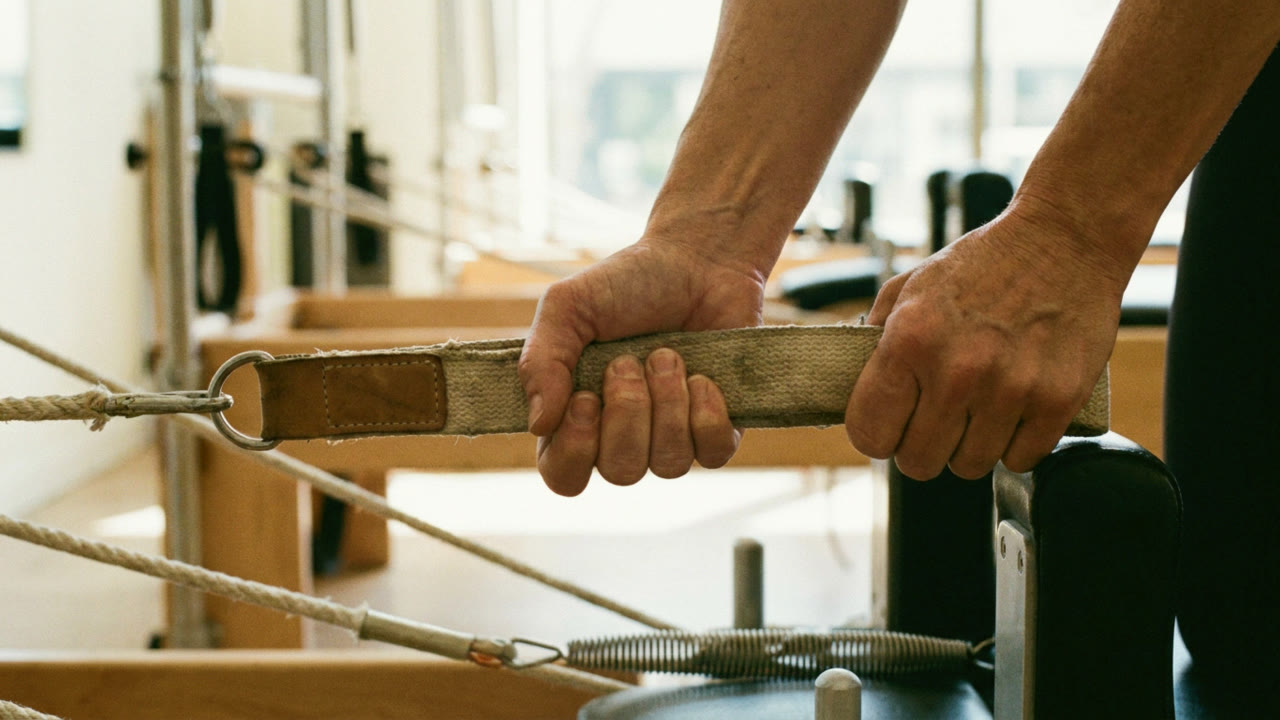
Bring the same principle into your Pilates. Working with springs rather than machines with fixed handles, and holding rather than resting the hands, changes what the session asks of you.
What to expect
Grip is one of the faster things to improve. Most women notice a practical difference in six to eight weeks, usually reported as something ordinary, the jar, the suitcase into the overhead locker, the dog that no longer pulls them off balance.
It is a small measure that reflects something much larger, which is precisely why it is worth paying attention to. If you are strengthening everything else, this is a free way to check whether it is working.
In my own teaching I build carrying and holding into the work deliberately, for exactly this reason. If you want a programme that treats strength as something to be built rather than maintained, that is what the Strength for Life is.
When the mind needs somewhere to land
Everything in this wing points, in the end, to the same place, the breath, and the nervous system beneath it. It is why I built SOVA: a quiet companion for the moments in between.
- Today, a daily practice that aligns you before the day pulls you a dozen directions.
- Companion, a place to process any feeling, even the happy ones.
- Pages, a soft place to set your thoughts down and out of your head.
- The House, rooms of calm to step into, whenever you need one.