
Why You're Not Getting Stronger, Even Though You Work Out
You go three times a week and you are as strong as you were eighteen months ago. The reason is almost always the same, and it is fixable in a month.
You go three times a week. You have gone for two years. You are fitter than most people you know. And you are, if you are honest, about as strong as you were eighteen months ago.
This is the most common frustration I hear, and it almost always comes down to the same thing.
Your body adapted, and then you stopped asking
Muscle is built in response to a demand it cannot comfortably meet. You ask for something slightly beyond current capacity, the body notices, and it rebuilds to be ready next time.
That process only continues while the demand keeps rising. The moment the ask becomes routine, the body has no reason to change. It is already equal to the job.
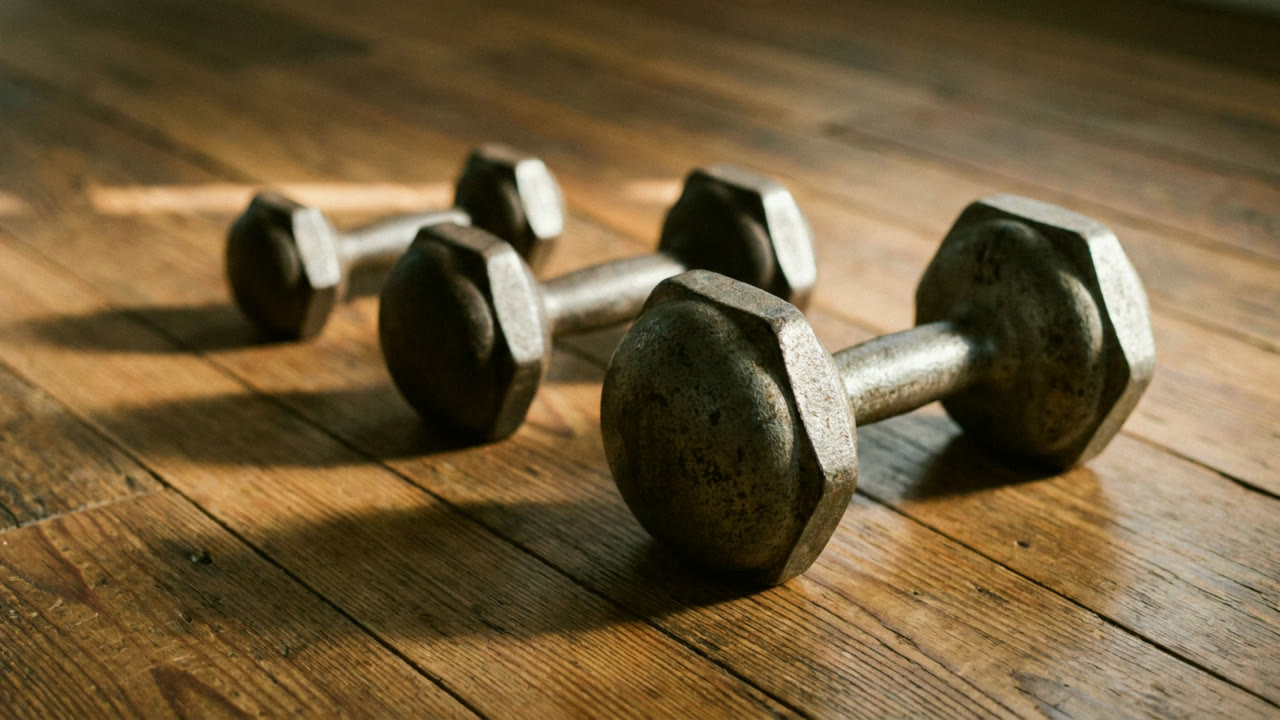
So the three-pound weights that were genuinely challenging in your first month become, by month four, a pleasant way to move your arms. Same movement, same effort in your mind, entirely different message to your muscle.
This is progressive overload, and it is not a bodybuilding concept. It is simply how muscle works, at every age.
The five-pound ceiling
Women in particular tend to find a weight that feels appropriate and then stay there for years.
Some of that is the fear of bulking up, which I want to name plainly: lifting heavier will not make you bulky. The hormonal profile required for that is not one most women have, and the women who do build significant size work extremely hard and eat deliberately to achieve it.
What lifting heavier will do is preserve the muscle you are otherwise losing at roughly one percent a year from your thirties, and hold on to bone density that declines sharply through perimenopause.
The last two repetitions should be genuinely hard. If you could comfortably do five more, that is not a strength set. It is a warm-up.
What progression actually looks like
Progression is not only about heavier weights, which is useful to know if heavier is not available or appropriate.
More load. The most direct route. Heavier dumbbell, stronger spring.
More repetitions at the same load, then add load and drop back down.
Slower tempo. Taking four seconds to lower rather than one dramatically increases the demand without changing the weight. This one is enormously underused.
Less stability. Same exercise on one leg, or on an unstable surface, asks far more of the system.
Greater range. Moving further through the movement, under control.
Shorter rest. Same work, less recovery between.
Any one of these, applied deliberately, is progression. Doing the same session at the same everything is not.
The other three reasons
You are not eating enough protein. You can train perfectly and still not build if the materials are not there. Most women I meet are well short. The numbers are in How Much Protein Do Women Actually Need.
You are not recovering. Muscle is built between sessions, not during them. If you are sleeping badly and training hard every day, you are repeatedly interrupting the process you are trying to cause.
You are not tracking anything. Almost nobody remembers accurately what they lifted six weeks ago. Without a note, progression becomes a feeling rather than a fact, and feelings drift downward. A page in a notebook is enough.
What to do about it this month
Pick two or three exercises you have done at the same level for a while. Write down exactly what you are currently doing.
Then change one variable. Add weight, or slow the lowering to a four count, or take a leg away. Keep everything else identical so you can tell what did the work.
Hold the new version for two to three weeks until it stops feeling hard, then change something again.
That is the entire method. It is not complicated, it is just easy to stop doing, because the sessions that feel comfortable are the ones we keep coming back to.
This is exactly what the Strength for Life was built around, because after thirty years in this work I am confident that the reason most women plateau is not effort or discipline. It is that nobody ever told them the ask has to keep rising.
When the mind needs somewhere to land
Everything in this wing points, in the end, to the same place, the breath, and the nervous system beneath it. It is why I built SOVA: a quiet companion for the moments in between.
- Today, a daily practice that aligns you before the day pulls you a dozen directions.
- Companion, a place to process any feeling, even the happy ones.
- Pages, a soft place to set your thoughts down and out of your head.
- The House, rooms of calm to step into, whenever you need one.