
How Much Protein Do Women Actually Need?
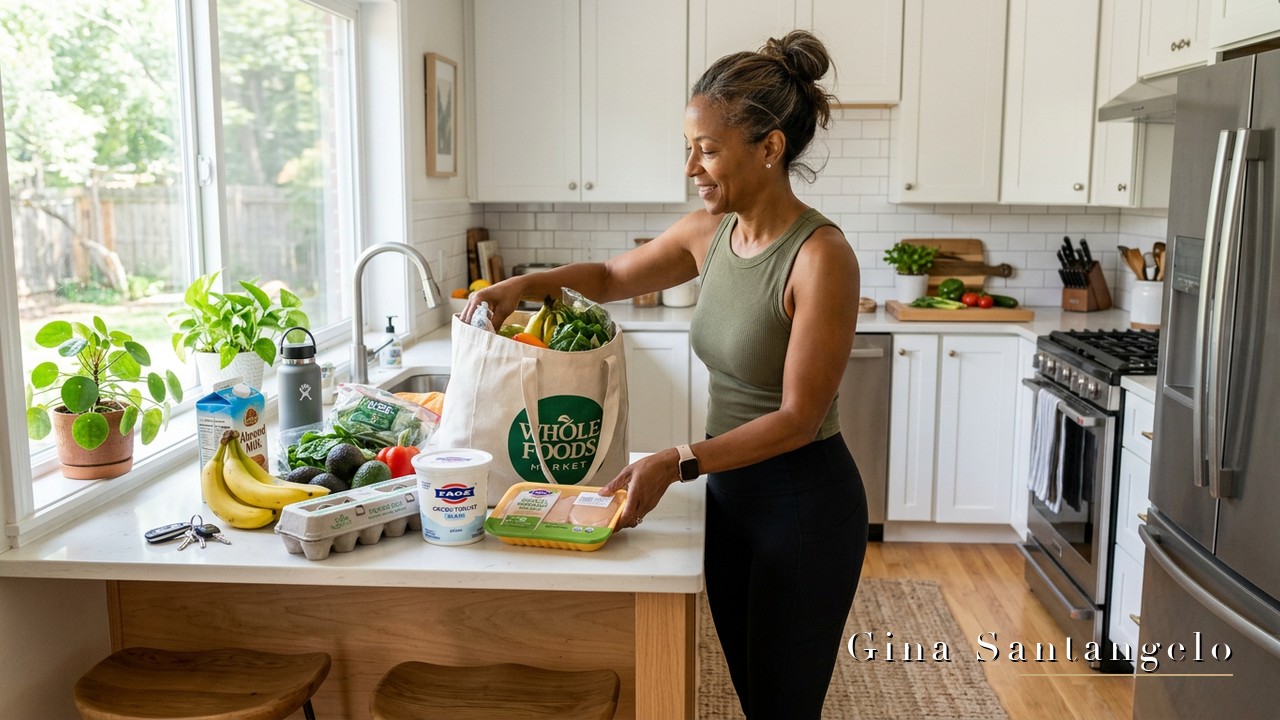
My floor is 100 grams a day, then a gram per pound of your weight or goal weight. Where Gabrielle Lyon and Stacy Sims agree, where they part ways, and what 30 to 40 grams looks like on a plate.
It is the question I get more than almost any other, and the honest answer is: probably more than you are eating now.
Most women I work with are eating somewhere between 45 and 60 grams of protein a day and assuming that is plenty. For almost anyone who wants to build or keep muscle, it is not.
So let me give you my answer first, before the reasoning.
How much protein do women actually need?
Never less than 100 grams a day. That is my floor, and I hold to it. Below that, in my experience, women simply do not see the changes they are working for.
Then, if you can, aim for one gram per pound of your body weight, or of your goal weight. That is the target.
A floor and a target, not a range. I do it that way on purpose. When you give someone a range, they take the bottom of it. The floor is what you hit on an ordinary busy day. The target is what you work toward.
For most women, 100 grams is already a meaningful increase, and it is achievable without rearranging your life. Three meals with roughly 30 to 35 grams each gets you there.
Your weight, or your goal weight?
Either. Use whichever gives you a number you can actually eat.
If you are near the weight you want to be, they are the same figure and there is nothing to decide. A woman at 140 pounds is aiming for around 140 grams.
If you are carrying more weight than you want to be, goal weight is the more sensible measure. A woman at 200 pounds who is working toward 150 should aim at 150 grams, not 200. Body fat does not have the same protein requirement that muscle does, so scaling to a weight you are moving away from gives you a number that is both unnecessary and, frankly, miserable to eat.
And if 150 is out of reach this month, you are back to the floor. One hundred grams. Start there.
Where the experts actually disagree
You will hear different numbers from different people, and I want to be straight with you about why, because the disagreement is smaller than it sounds.
Dr. Gabrielle Lyon recommends one gram per pound of your target body weight, with 30 to 50 grams at your first and last meals of the day.
Dr. Stacy Sims recommends 0.9 to 1.2 grams per pound of your current body weight for active women, rising toward the top of that range during perimenopause and menopause as the body becomes less responsive to protein. She wants 30 to 40 grams per meal, and 30 to 40 grams within about 45 minutes after you train.
Look at what happens with real numbers. For a woman at 140 pounds, Lyon lands on 140 grams and Sims lands between 126 and 168. Lyon's figure sits in the middle of Sims's range. They are not really arguing.
The one place they genuinely part ways is the woman carrying extra weight, and there Lyon's goal-weight approach gives the kinder number.
I sit between the two, which is where my floor and my target come from. And I will tell you plainly: both of them are above where the wider research consensus sits, which lands nearer 0.7 grams per pound. They are ahead of it deliberately, and they have their reasons. I lean their way because of what I watch happen in women who raise their protein, not because the literature has finished the argument.
Does the number change over time?
It goes up, which surprises people. We assume that as the years pass we need less of everything. Protein works the other way.
The body becomes less efficient at turning the protein you eat into muscle. Researchers call it anabolic resistance. The same 20 grams that produced a strong muscle-building response at thirty produces a smaller one at sixty. So the requirement rises at precisely the point most women start eating less.
But do not read this as a problem that begins at fifty. Muscle mass starts declining from around age thirty without deliberate effort. A woman in her thirties who gets her protein and her strength work in place is not fixing a problem. She is avoiding one, and she has the most time of anyone to benefit.
Does it matter when I eat it?
Yes, more than most people expect. Total daily protein matters most, but distribution matters too.
Most women eat very little protein at breakfast, a moderate amount at lunch, and the majority at dinner. The body cannot bank it. Aiming for 30 to 40 grams at each main meal gives you several genuine muscle-building signals across the day instead of one late one.
Breakfast is almost always where the biggest improvement is available. If your morning is toast and coffee, that is a meal doing nothing at all for your muscle, and it is the easiest one to change.
If you train, get 30 to 40 grams in within about forty-five minutes afterwards. That is the one piece of timing advice I think is genuinely worth the effort.
What 30 to 40 grams actually looks like
Numbers on a page are hard to act on. Here is what it looks like in real food:
- 5 ounces of chicken breast
- 6 ounces of salmon
- 1 cup of Greek yogurt with a tablespoon of hemp seeds
- 5 whole eggs, or 3 eggs with half a cup of cottage cheese
- 1 cup of cottage cheese with a scoop of protein powder stirred through
- 6 ounces of lean steak
- 1.5 cups of cooked lentils with a slice of sprouted grain bread
Three of those in a day puts you at or above the floor.
If you eat plant-based
You can absolutely build muscle without animal protein. It takes more attention, not more willpower.
Plant proteins are less efficiently used by the body and most are lower in leucine, the amino acid that does the most to trigger muscle building. So you will want to sit at the higher end of your target rather than the floor, and combine sources across the day rather than relying on one. Tempeh, legumes, seeds, soy and grains together cover what any one of them misses alone.
Both Lyon and Sims say the same thing here, which is worth noting given they disagree elsewhere.
Do I need a protein powder?
I recommend one, and I do not say that lightly about anything you have to buy.
Here is why. The numbers above are not hard to understand, they are hard to eat. Getting 100 grams into a day that already contains work, other people and a commute usually means one meal has to be effortless, and a shake is the most reliable way I know to make one meal effortless. The women I see fall short are almost never the ones who did not understand the target. They are the ones who ran out of time at eleven in the morning.
Whey isolate is the one I recommend. It absorbs quickly, it is high in leucine, which is the amino acid that does the most to switch on muscle building, and the isolate form has had most of the lactose and fat filtered out, so it tends to sit well with women who find regular whey concentrate heavy. Lyon and Sims both point to the same thing, particularly around training.
Treat it as food rather than a supplement. Look for a short ingredient list and a third-party testing mark on the label, which tells you an outside lab has checked that what is in the tub matches what is on it.
The one I use is Kion Clean Protein in Rich Chocolate. It is a grass-fed whey isolate and the ingredient list is short enough to read in a breath: whey protein isolate, organic cocoa, natural chocolate flavour, pink salt, stevia leaf extract, sunflower lecithin. Twenty grams a scoop. It is a very clean brand and it is what is in my kitchen.
That said, it is not the only good one, and brands get bought and quietly reformulated. So read the label on whatever you choose against the same standard, and the criteria will outlast any recommendation I could give you.
It is not a replacement for eating well. It is a way of removing one obstacle on the days that get away from you, and those are the days that decide whether any of this holds. I have written more about choosing one in The Power of Protein Powders.
Protein alone will not build muscle
This is the part that gets left out of most articles about protein, and it is the part I care about most.
Eating more protein without asking anything of your muscles does not build muscle. It gives the body materials with no instruction to use them. The instruction is resistance, progressively increased over time. Springs that get heavier. Weights that go up. Work that asks more of you this month than it did last month.
That is why protein and strength work belong in the same conversation. One without the other leaves most of the benefit on the table.
Where to start this week
Do not overhaul anything. Change breakfast.
Get 30 to 40 grams into your first meal of the day, every day, for one week. That is the single change that moves most women closest to the floor, and it is the one that tends to stick, because mornings are the most repeatable part of anyone's day.
Once breakfast holds, look at lunch. Most women find they are at 100 grams without having thought very hard about dinner at all.
In the studio in Ridgewood, this is the conversation I have with women every week, because strength work and adequate protein are the two halves of the same goal. If you want help putting both in place, that is exactly what the Strength for Life was built for.
When the mind needs somewhere to land
Everything in this wing points, in the end, to the same place, the breath, and the nervous system beneath it. It is why I built SOVA: a quiet companion for the moments in between.
- Today, a daily practice that aligns you before the day pulls you a dozen directions.
- Companion, a place to process any feeling, even the happy ones.
- Pages, a soft place to set your thoughts down and out of your head.
- The House, rooms of calm to step into, whenever you need one.