Neck and Shoulder Tension: Why It Keeps Coming Back
Massage helps for a day, stretching for an hour, then it returns. The muscle is not tight because it is short, it is tight because it is doing another muscle's job. What actually changes it.
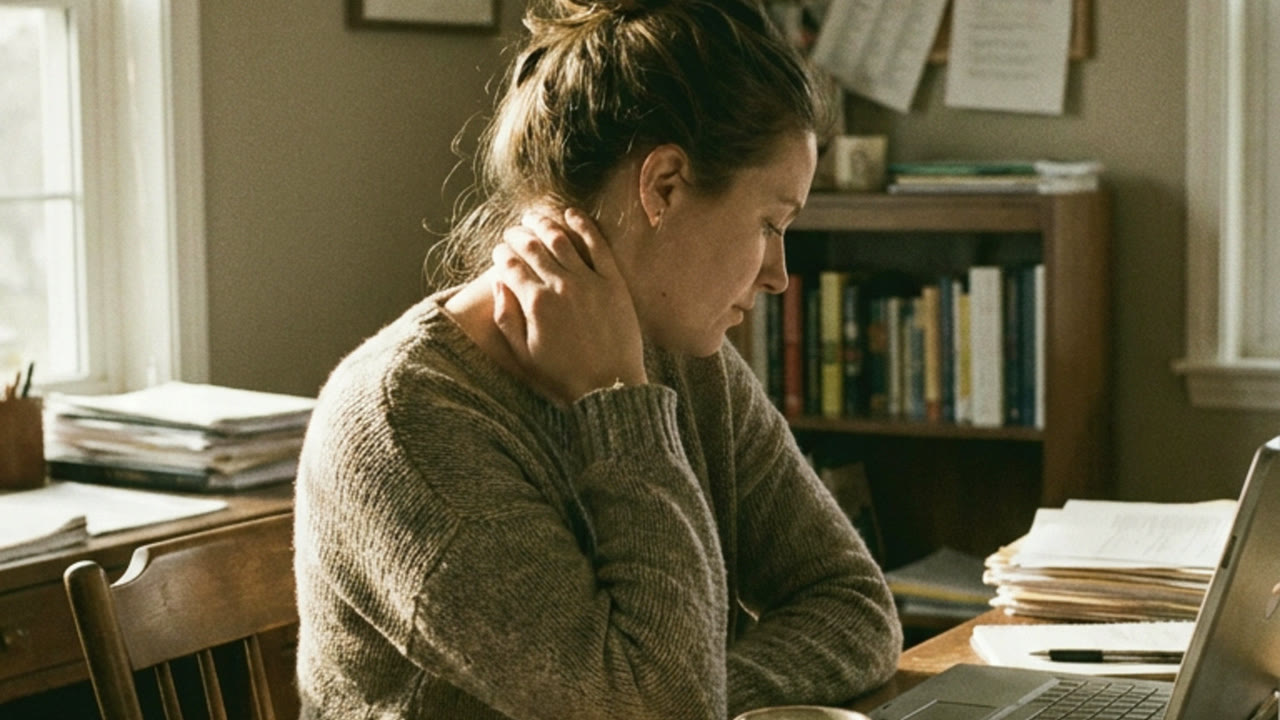
Most women I see carry it in the same place, a band across the top of the shoulders and up into the base of the skull, permanently a little tight, worse by Thursday.
They have usually tried massage, which helps for a day or two, and stretching, which helps for an hour. Then it comes back, and they conclude they are just a tense person.
They are usually not. It is generally mechanical.
Where it comes from
The head has drifted forward. A head weighs roughly ten to twelve pounds when balanced over the shoulders. Move it forward and the effective load on the neck and upper back multiplies considerably. The muscles across the top of your shoulders are holding that, all day, without a break.
The shoulder blades have stopped working. The muscles between them lengthen and switch off with sustained sitting. When the lower and middle trapezius stop stabilising, the upper trapezius takes over, and it was never designed to be the primary support.
The chest has shortened. Arms forward all day, at a keyboard or a steering wheel or a phone, and the front of the shoulder gradually settles closed. Which pulls the shoulders further forward, which pushes the head further forward again.
You are breathing into your chest. Shallow upper-chest breathing recruits the neck muscles as accessory breathing muscles. Twenty thousand breaths a day. If your neck is helping you breathe, it never gets to rest.
Why massage does not hold
Not because massage is useless, it genuinely relieves the tissue. But it addresses the muscle that is complaining rather than the reason it is being asked to work.
If the upper trapezius is doing the job of muscles that have stopped participating, releasing it just returns it to the same job. It will be tight again by the weekend, and it will keep being tight until something else takes the load.
That something else has to be trained.
What actually changes it
Wake up the mid-back. The muscles between and below the shoulder blades. Rows, scapular squeezes, anything that draws the shoulder blades down and together. This is the single highest-value thing on the list.
Open the front of the chest. A doorway stretch, forearms on the frame, stepping gently through. Thirty seconds each side. It creates the room for the shoulders to sit back.
Fix the breathing. Lateral breathing into the sides and back of the ribs takes the neck out of the job. This is the same system I describe in The Three Types of Breathwork I Teach, and it matters more here than people expect.
Move the head back over the shoulders. Chin tucks, a gentle glide backwards, not a nod. Ten, several times a day. It feels like almost nothing and it retrains where neutral is.
Deal with the screen and the phone. No amount of exercise outruns eight hours of looking down. More in Desk Posture: There Is No Correct Way to Sit.
The bit people skip
Stretching the tight muscle feels productive and is rarely the fix. The upper trapezius is not tight because it is short. It is tight because it is overworked.
You do not solve an overworked muscle by lengthening it. You solve it by giving the work to something else.
Which is why women who stretch their neck diligently for months see very little change, and women who spend six weeks strengthening the mid-back often find the neck quietly stops bothering them without ever having been addressed directly.
When it is worth getting checked
Please see a doctor if there is numbness or tingling into the arm or hand, weakness in a grip, pain that wakes you consistently, headaches that are new or changing in character, or any of it following an accident.
Ordinary mechanical tension does not do those things.
For everything else, this is a genuinely fixable problem, and usually faster than people expect. If you would like someone to look at what your shoulders are actually doing, start with a conversation.
When the mind needs somewhere to land
Everything in this wing points, in the end, to the same place, the breath, and the nervous system beneath it. It is why I built SOVA: a quiet companion for the moments in between.
- Today, a daily practice that aligns you before the day pulls you a dozen directions.
- Companion, a place to process any feeling, even the happy ones.
- Pages, a soft place to set your thoughts down and out of your head.
- The House, rooms of calm to step into, whenever you need one.