Movement · The Practice
A Pilates Vocabulary
The short answer
Everything you need to be in the know, the movement terms I’ll use as you work.
- Abdominals, four muscles: the rectus abdominis (down the center), the external and internal obliques (the sides, for bending and twisting), and the deepest, the transversus abdominis (TVA), which wraps like a corset and stabilizes the trunk.
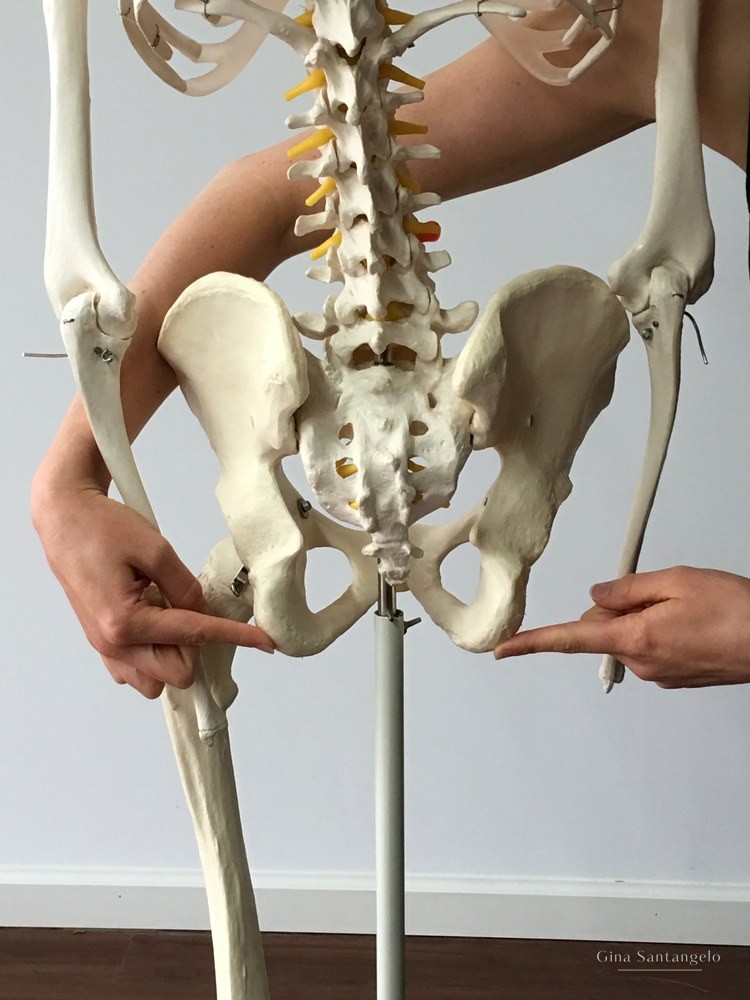
- ASIS, the two bony points at the front of the pelvis; you can feel them moving your hands down from the waist to the crest of the hips.
- Articulation, rolling the spine one vertebra at a time, so each has space to move independently.
- C-Curve, a rounding of the back; the shape of the lower spine as you scoop the abdominals in.
- Extension, a movement that carries a body part backward from neutral.
- Neutral pelvis, the pelvis in its most naturally efficient alignment: not tucked under, not arched, not hiked to one side. The ASIS and pubic bone share one plane.
- Nod the chin, a gentle lengthening of the back of the neck, leaving space between chin and throat (as if holding a small tangerine there).
- Prone / Supine, lying on your belly / lying on your back.
- Tabletop legs, on your back, knees bent and lifted so the shins are parallel to the floor at 90 degrees.
- Sitz bones, the two bony points at the very base of the pelvis (the ones you sit on).
- Dorsiflexion / Plantar flexion, flexing the ankle so the toes lift / pointing the toes down.
- Hyperextension, straightening a joint beyond its limit (locked knees, for example). We avoid this.
- Range of motion, moving a muscle or limb comfortably through its full range.